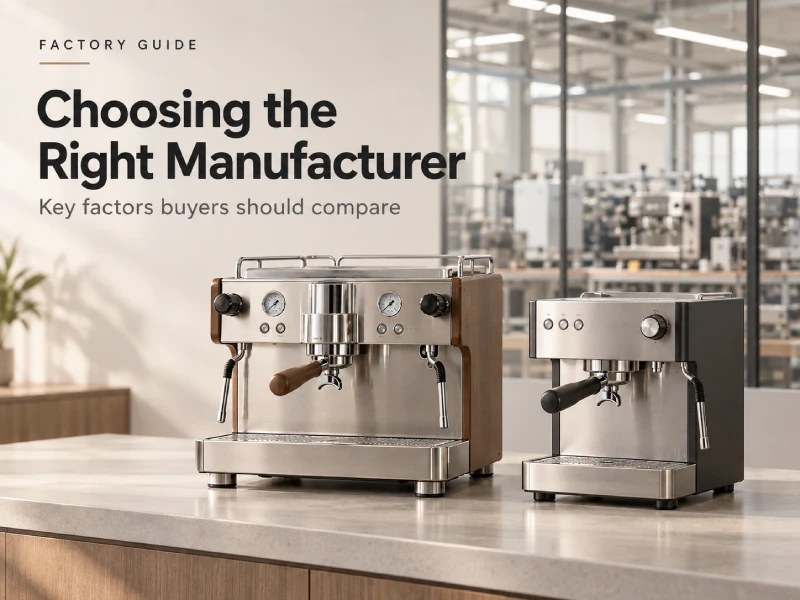
Choosing a coffee machine manufacturer in China should involve much more than comparing unit prices. A reliable sourcing decision needs to consider product fit, manufacturing capability, engineering support, quality control, compliance documentation, MOQ, samples, lead time, commercial terms and after-sales support.
If you are evaluating how to choose a coffee machine manufacturer in China, start with seven areas:
- Product fit
- Manufacturing capability
- OEM/ODM capability
- Quality control
- Compliance evidence
- Commercial terms
- After-sales support
The goal is not simply to find the largest factory or the lowest quotation. It is to identify a supplier whose products, processes, documentation and commercial capabilities match your project, and whose claims can be verified before you commit to mass production.
Define Your Coffee Machine Sourcing Requirements First
Before contacting suppliers, define what you actually need. A vague request such as “I need a coffee machine” forces the supplier to make assumptions and makes quotations difficult to compare.
Product Category and Target User
Start by identifying the product category:
- Espresso coffee machines
- Capsule coffee machines
- Coffee grinders
- Drip coffee machines
- Commercial coffee machines
- Coffee machine accessories
Then define the target user. A compact espresso machine for e-commerce has different requirements from a machine intended for offices, cafés, hotels or distributors. Prepare a basic specification covering capacity, voltage, plug type, heating system, interface, accessories and packaging expectations.
Target Market and Sales Channel
Tell potential suppliers your target country or region, sales channel, customer segment, market position and launch schedule. Electrical configuration, documentation, packaging and compliance requirements can vary between markets.
Sourcing Path
You should also decide whether your project is closer to ready stock, wholesale, private label, OEM or ODM. Ready-stock projects prioritize speed. Private-label projects usually begin with an existing product platform, while OEM and ODM projects can involve substantially more engineering work.
If you are still deciding between these approaches, compare OEM and ODM before defining the final project scope.
Check Whether the Manufacturer Fits Your Product Category
A company that manufactures coffee machines is not automatically suitable for every coffee machine project.
A supplier may have strong capsule-machine experience but limited experience with pump espresso machines. Ask whether the manufacturer produces your target category consistently and already has relevant models or platforms.
| Buyer Requirement | Evidence to Request | Why It Matters |
|---|---|---|
| Espresso machine range | Model list and specifications | Confirms category experience |
| Private label support | Customization option list | Confirms project feasibility |
| Target market | Relevant product documentation | Helps assess market readiness |
| Similar application | Comparable models or samples | Shows practical product experience |
| Key components | Technical specifications | Helps evaluate product architecture |
Product fit is often more important than the total number of products in a supplier’s catalogue. A focused coffee machine factory with mature platforms in your category may be a better partner than a much larger appliance manufacturer for which coffee machines are only a minor product line.
Verify the Company and Factory Behind the Quote
Before discussing a large order, establish exactly who you are doing business with.
Verify the Legal Entity
Request and compare the legal company name, business registration information, factory address, company named on the quotation, company named in the sales contract, payment beneficiary and export entity where relevant.
These details do not always need to be identical, but the relationship between manufacturing, export, contracting and payment entities should be clear.
Understand the Supplier’s Actual Role
Trading companies are not automatically unsuitable; some provide useful sourcing or project-management services. Instead, establish:
- Who manufactures the machine?
- Who handles engineering discussions?
- Who is responsible for quality control?
- Who controls production schedules?
- Who assumes contractual responsibility?
- Can the actual production location be verified?
This is more useful than relying only on whether a salesperson describes the business as a factory.
Request Factory Evidence
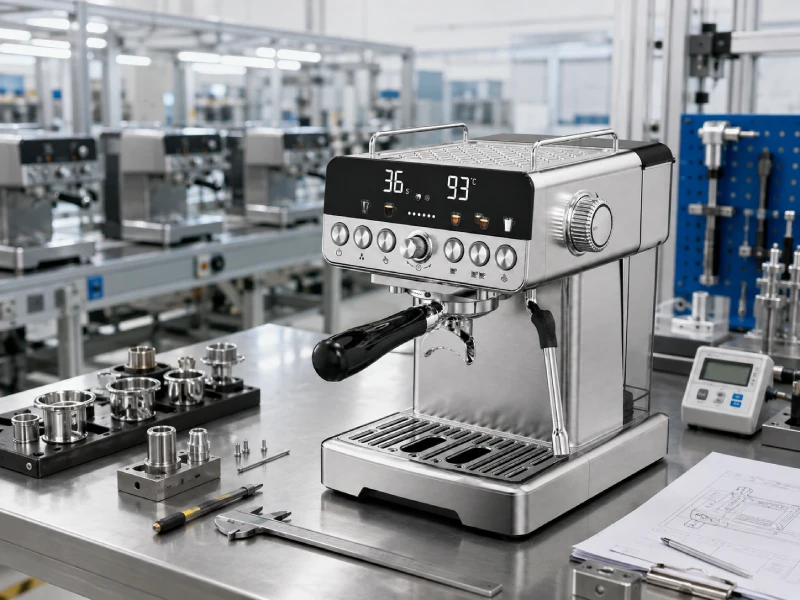
Ask for production-line photos or videos, key manufacturing stages, QC procedures, testing equipment and packaging operations. For higher-risk projects, consider an online factory tour, third-party audit or physical visit.
Reviewing a supplier’s coffee machine manufacturing capabilities should help you understand what is performed in-house and which processes depend on external partners.
Evaluate Engineering and OEM/ODM Capability
Many buyers use the word OEM for almost every type of customization. In practice, customization capability can vary significantly between manufacturers.
A supplier capable of printing your logo may not necessarily be able to modify a control system, redesign internal structures or develop new tooling.
| Customization Level | Typical Scope | Evidence to Request |
|---|---|---|
| Private Label | Logo, color, packaging | Artwork approval and sample process |
| Platform Customization | Panel, accessories, selected functions | Engineering feasibility review |
| Full Development | Structure, tooling, new functions | Formal development workflow |
For private-label projects, review artwork, color, packaging and sample approval. For platform customization, ask who evaluates component, control-panel, firmware or functional changes.
For deeper OEM/ODM coffee machine development, evaluate whether the supplier can support structural modification, new functions, tooling, engineering prototypes, sample iteration, technical validation, Golden Sample approval, engineering change control and mass-production introduction.
Ask how changes are documented. If a component, firmware, structure or material changes after sample approval, there should be a controlled review and record.
MOQ, tooling cost, engineering fees, development time and validation requirements should always be confirmed according to the actual project rather than assumed from a standard sales quotation.
Review Quality Control and Compliance Evidence
Quality claims are easy to make. Evidence is more useful.
Check Product-Level Documents
First, distinguish between a product certificate, laboratory test report, declaration of conformity, factory management-system certificate and shipment inspection report. They do not prove the same thing.
When reviewing product-related compliance evidence, check:
- Exact model number or model family
- Applicable test standard
- Test or certification organization
- Report or certificate number
- Issue date and revision
- Product specifications covered
- Target-market applicability
- Whether your customized version remains within the documented scope
This is especially important when changing electrical components, heating systems, control boards or other safety-relevant parts. In the EU, for example, CE compliance involves applicable requirements, conformity assessment, technical documentation and the required declaration—not merely a certificate page.
Always confirm current requirements with the importer, local compliance specialist, testing laboratory, certification body or relevant authority for the destination market.
Review Quality Control Stages
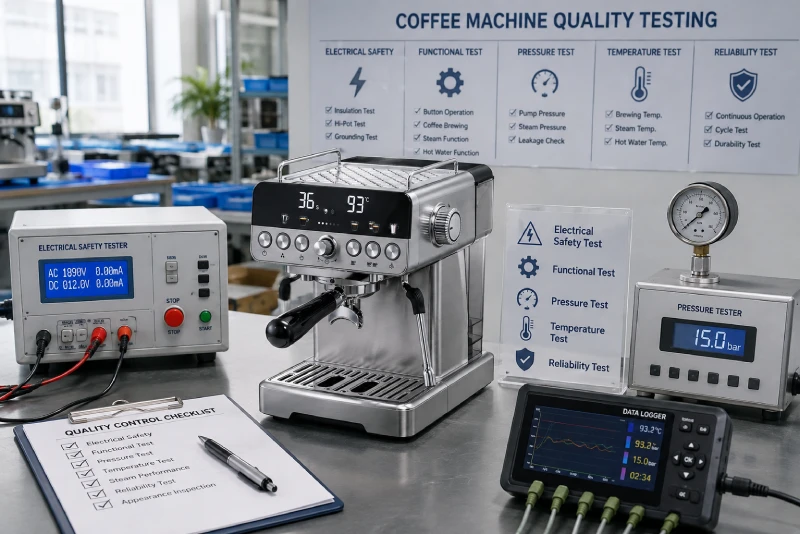
A credible coffee machine quality control process should extend beyond checking finished cartons.
Ask how the manufacturer manages:
- Incoming component inspection
- Assembly-stage checks
- Electrical safety testing
- Functional testing
- Reliability validation
- Final product inspection
- Packaging inspection
- Pre-shipment inspection
For coffee machines, this may cover electrical safety, heating performance, pumps, water systems, brewing functions, leak checks and temperature behaviour. Ask to see the process and relevant records rather than relying only on a “100% inspection” claim.
Consider Independent Inspection
Independent inspection is particularly useful for first orders, new models, large batches or strict cosmetic and packaging requirements. Base inspection on an agreed specification and acceptance checklist.
Compare Samples, MOQ, Lead Time and Total Project Cost
Unit price is only one part of a sourcing decision. Two suppliers quoting similar machine prices may produce very different total project costs.
Compare:
- Sample cost
- Sample delivery
- Product MOQ
- Color MOQ
- Customized packaging MOQ
- Tooling or engineering cost
- Certification or testing cost
- Spare-parts cost
- Third-party inspection cost
- Production lead time
- Packaging preparation time
- Pre-shipment preparation
Ask suppliers to state the assumptions behind each quotation, including packaging, color, product configuration, order quantity and accessories. Distinguish sample lead time from mass-production lead time because tooling, packaging and engineering changes can add separate stages.
For a deeper comparison, review coffee machine MOQ and lead time before using MOQ alone to eliminate potential suppliers.
Review Commercial Terms and After-Sales Support
A professional quotation should clearly explain what is included and excluded.
Review the product version, accessories, packaging, customization scope, quotation validity, Incoterm, payment milestones, sample approval, production assumptions and inspection arrangement. Keep specifications in controlled written records rather than scattered messages.
After-sales arrangements also matter. Discuss warranty terms, recommended spare parts, troubleshooting, defect reporting, claim evidence, batch traceability, corrective actions and notification of important product changes.
The objective is not to demand unrealistic guarantees. It is to establish how problems will be investigated and resolved if they occur.
Use a Coffee Machine Supplier Comparison Scorecard
Supplier selection becomes more consistent when buyers score evidence rather than relying on impressions from sales conversations.
| Evaluation Item | Weight | Evidence Required | Supplier A | Supplier B | Risk Note |
|---|---|---|---|---|---|
| Product fit | 15% | Model list and specifications | |||
| Factory verification | 10% | Legal and factory evidence | |||
| Engineering capability | 15% | Sample and development workflow | |||
| Quality control | 15% | QC process and test records | |||
| Compliance | 10% | Relevant certificates and reports | |||
| MOQ and lead time | 10% | Written project assumptions | |||
| Quote transparency | 10% | Cost breakdown | |||
| After-sales support | 10% | Warranty and spare-parts plan | |||
| Communication | 5% | Response and change control |
Score each supplier from 1 to 5, apply the weighting and add a risk note. A strong overall score should not hide a critical unresolved issue such as unclear compliance coverage or an unverified production site. Evidence should support every rating: quality claims need records, OEM capability needs engineering evidence, and lead-time claims need written assumptions.
This turns a general coffee machine supplier checklist into a repeatable purchasing process.
Red Flags to Watch Before Placing an Order
No single warning sign automatically proves that a supplier is unreliable. However, several unresolved issues should trigger further verification.
Watch for situations where:
- The actual manufacturing entity cannot be identified.
- Certificates cannot be connected to the quoted model.
- Quotations do not define the product specification or version.
- The supplier never asks about target market, voltage or plug type.
- Identical MOQ and lead-time promises are given for every customization request.
- There is no structured sample approval process.
- Packaging, testing or inspection responsibilities remain unclear.
- Payment is requested to an unexplained entity unrelated to the contract.
- Important specifications change repeatedly without written records.
Do not assume one warning sign proves a supplier is unreliable. Ask for clarification and evidence; the quality of that response is useful information.
Final Manufacturer Selection Checklist
Before approving a supplier for mass production, confirm that:
- Product and market requirements are defined.
- Factory identity has been verified.
- Model specifications are documented.
- Customization scope has been confirmed.
- Compliance requirements have been reviewed.
- Sample approval process has been agreed.
- MOQ and timeline assumptions are written.
- QC and inspection procedures are understood.
- Commercial terms have been reviewed.
- After-sales responsibilities are documented.
The next step is to convert these requirements into a structured RFQ. A well-prepared OEM coffee machine RFQ allows manufacturers to evaluate your project more accurately and makes competing quotations easier to compare.
FAQ
How can I verify a coffee machine manufacturer in China?
u003cpu003eCheck the supplieru0026#039;s legal identity, factory location, quotation and payment entities, production evidence, QC process and relevant product documentation. For important projects, consider a video audit, third-party factory audit or on-site visit.u003c/pu003e
Should I work directly with a factory or a trading company?
u003cpu003eNeither structure is automatically better. A direct factory may provide closer production and engineering communication, while a trading company may provide useful coordination services. The key is knowing who manufactures the product, who controls quality and who carries contractual responsibility.u003c/pu003e
Can I request a sample before placing a bulk order?
u003cpu003eYes. Sample evaluation is an important part of coffee machine sourcing, particularly for a new supplier or customized product. Confirm whether the sample represents the intended production configuration and document any differences before mass production.u003c/pu003e
What certifications should I check for my target market?
u003cpu003eRequirements depend on the destination, product configuration, electrical specifications, application and sales channel. Ask for documents applicable to the exact model and confirm current requirements with the relevant importer, testing laboratory, certification body or local authority.u003c/pu003e
How should I compare quotes from different coffee machine suppliers?
u003cpu003eMake sure suppliers are quoting the same specifications, accessories, packaging, customization, quantity, Incoterm, testing requirements and compliance assumptions. Then compare total project cost rather than unit price alone.u003c/pu003e
What information should I provide before requesting a factory quote?
u003cpu003eProvide your target market, coffee machine category, intended sales channel, estimated quantity, required specifications, electrical requirements, customization scope, packaging needs, compliance expectations and target launch schedule.u003c/pu003e
Choose Evidence, Not Claims
The best coffee machine supplier is not necessarily the one with the largest catalogue, lowest price or fastest reply. A stronger decision comes from matching the manufacturer to your product category, verifying the factory, reviewing engineering capability and checking quality, compliance and commercial evidence before production.
Apply the same evaluation framework to every supplier you shortlist, including YSELE. Compare model suitability, factory and quality evidence, customization feasibility, samples, documentation, costs and project responsibilities before making the final decision.
If you already have a target product and market in mind, submit your coffee machine project requirements with your estimated quantity, customization needs and expected launch schedule for an initial project review.