When importers ask about coffee machine MOQ and lead time, there is rarely one number that applies to every project. A ready-stock order, a standard wholesale order, a private-label project, and an OEM/ODM development project follow different purchasing and production paths.
MOQ can be affected by the model, color, packaging, custom components, and material requirements. Lead time may include much more than assembly: sample preparation, engineering confirmation, material purchasing, testing, inspection, packaging, and buyer approval can all affect the schedule.
The practical approach is to identify which parts of the project are standard, which are customized, and which conditions still need supplier confirmation.
Why Coffee Machine MOQ and Lead Time Are Project-Specific
MOQ is often understood as the minimum number of finished machines a supplier will accept. In practice, several minimum quantities can exist inside one project.
The complete machine may have one MOQ, while a custom color, printed gift box, branded manual, accessory, control panel, or other customized part may have another. A supplier may therefore be able to produce the requested quantity of machines while still facing a higher purchasing minimum for a specific material or packaging item.
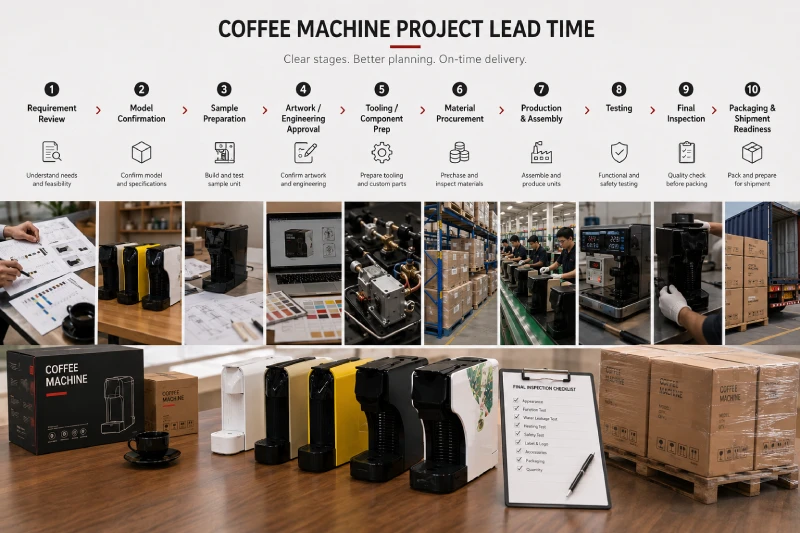
Lead time works the same way. It is not simply the number of days required for assembly. The full schedule may include requirement review, sampling, artwork approval, engineering, material procurement, production, testing, inspection, packaging, and shipment preparation.
For this reason, buyers should ask suppliers to break MOQ and timing down by stage instead of relying on one headline figure.
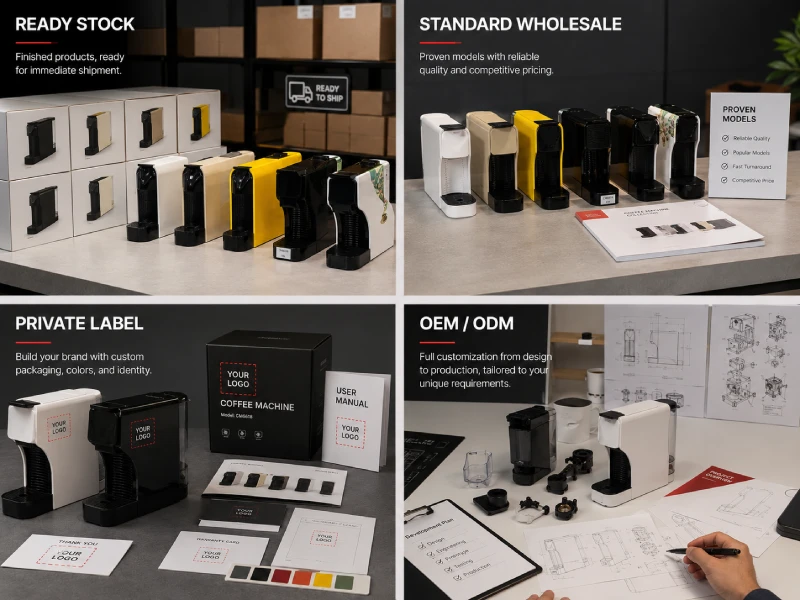
Compare the Four Main Sourcing Routes
| Sourcing Route | Starting Point | MOQ Tendency | Lead-Time Stages | Best Fit |
|---|---|---|---|---|
| Ready Stock | Finished or available models | Depends on availability | Selection and shipment preparation | Urgent or trial demand |
| Standard Wholesale | Existing model | Model-dependent | Production and inspection | Distributors |
| Private Label | Existing platform with branding | Affected by logo and packaging | Sample, artwork, production | Brand launch |
| OEM/ODM | Modified or new product | Project-dependent | Engineering, validation, production | Differentiated projects |
If speed is the priority, buyers can first review ready stock coffee machines to see whether an available model meets the market requirement.
Importers building a brand around an existing platform may be better suited to wholesale and private label coffee machines, where the main changes involve branding, packaging, or selected appearance options.
Projects involving structural changes, new tooling, modified functions, custom electronics, or new product engineering should instead be evaluated as OEM/ODM coffee machine development.
What Determines Coffee Machine MOQ?
Product and Model
Different coffee machine platforms use different components, tooling, assembly processes, and supply chains. A model already produced regularly may have different purchasing conditions from a less frequently manufactured configuration.
Color and Housing
Special colors can affect MOQ when they require custom painting, molding, metal finishing, or other surface treatments. The limitation may come from raw-material or processing suppliers rather than the final assembly line.
Custom Components
Customized parts may introduce separate MOQ requirements, including:
- Control panels
- PCB or firmware
- Custom accessories
- Heating or brewing components
- Structural parts
Packaging
Printed boxes, manuals, labels, barcodes, inserts, and export cartons may have their own printing or material minimums. As a result, the machine quantity and packaging quantity may not always be identical.
Mixed-SKU Orders
Importers often want to combine several models or colors in one purchase order. This may be possible, but the supplier needs to confirm whether quantities can be combined or whether each SKU must meet its own production, material, or packaging requirement.
Break Lead Time into Clear Stages
A useful coffee machine production schedule should be presented as a sequence of stages:
- Requirement review
- Model or platform confirmation
- Sample preparation
- Engineering or artwork approval
- Tooling or custom-component preparation
- Material procurement
- Production and assembly
- Functional and safety testing
- Final inspection
- Packaging and shipment readiness
Not every order requires all ten stages. Ready-stock projects may skip most development steps, while OEM projects can require several rounds of engineering and validation.
| Stage | Buyer Input | Supplier Output | Dependency | Estimated Time |
|---|---|---|---|---|
| Requirement review | Product brief | Feasibility feedback | Complete input | To be confirmed |
| Sample | Sample requirements | Sample unit | Parts availability | To be confirmed |
| Artwork / engineering | Files and specifications | Approval solution | Buyer confirmation | To be confirmed |
| Production | Approved specification | Bulk production | Material readiness | To be confirmed |
| Inspection | Inspection criteria | Inspection result | Production completion | To be confirmed |
Before requesting a quotation, buyers can prepare an OEM coffee machine RFQ covering market, configuration, customization, compliance requirements, and target timing. Better information at the RFQ stage usually produces a more meaningful schedule.
What Commonly Extends Coffee Machine Lead Time?
Lead time often moves because the project changes after the initial quotation.
Common causes include:
- Incomplete product requirements
- Specification changes after sample review
- Late packaging artwork
- Special colors or materials
- New tooling
- New function development
- Custom electronic components
- Certification or testing adjustments
- Delayed Golden Sample approval
- Multiple models or colors
- Rework after final inspection
Buyers should therefore separate supplier-controlled production time from project time that depends on buyer approvals, component vendors, testing, or corrective work. A realistic schedule should show these dependencies rather than hiding them inside one promised completion date.
Why a Lower MOQ May Change Total Cost
A lower MOQ can help buyers test a market, launch a new brand, or reduce initial inventory exposure. However, it may change how project costs are allocated.
Production setup, packaging printing, custom-component purchasing, sample preparation, engineering, inspection, and logistics do not always scale directly with order quantity. A packaging supplier may still require a minimum print run, for example, even when the machine quantity is reduced.
This does not mean a lower MOQ is always more expensive per unit. The effect depends on the model, sourcing route, packaging, customization, and shipment structure.
Instead of asking only whether the supplier can reduce MOQ, ask: “Which cost items or project conditions change if we reduce the quantity?” That gives a clearer basis for comparing inventory risk against total landed project cost.
How Buyers Can Reduce MOQ and Lead-Time Risk
The simplest way to reduce uncertainty is to remove unnecessary variables before production begins.
Useful steps include:
- Start from a mature product platform when possible
- Separate must-have requirements from optional features
- Limit colors and SKUs in the first order
- Confirm voltage, plug type, and target market early
- Prepare logos, labels, packaging, and manuals in advance
- Freeze specifications after Golden Sample approval
- Assign one person to make final approvals
- Request a stage-by-stage schedule from the supplier
- Reserve time for inspection and possible adjustment
- Provide realistic future-order forecasts without making unsupported commitments
Quality planning should also be included before mass production. Reviewing the coffee machine quality control process helps buyers understand where functional checks, safety testing, and final inspection fit into the schedule.
Questions to Ask Every Supplier
Before confirming an order, ask:
- Is MOQ calculated by model, color, packaging version, or total order quantity?
- Are sample and mass-production MOQ requirements different?
- From which exact milestone does lead time begin?
- Does material purchasing start only after deposit receipt?
- What is the deadline for packaging artwork and manuals?
- Which customization items add engineering or material lead time?
- Can specifications change after Golden Sample approval?
- Is inspection and possible rework included in the schedule?
- Does the quoted date mean production complete or shipment ready?
- Which MOQ, cost, or timing conditions remain “to be confirmed”?
These answers usually reveal more about project readiness than a single MOQ or delivery figure.
MOQ and Lead-Time Planning Worksheet
Use this table when comparing suppliers or preparing an internal purchase plan.
| Item | Buyer Requirement | Supplier Response | Dependency | Owner | Target Date | Status |
|---|---|---|---|---|---|---|
| Product model | ||||||
| Quantity | ||||||
| Color | ||||||
| Packaging | ||||||
| Certification | ||||||
| Sample approval | ||||||
| Production | ||||||
| Inspection |
Pay particular attention to “Dependency” and “Owner.” If packaging is waiting for buyer approval, or a custom part is waiting for a vendor, the schedule should make that visible.
FAQ
What is the typical MOQ for a coffee machine order?
u003cpu003eThere is no universal MOQ for coffee machines. The required quantity depends on the model, sourcing route, color, packaging, and customization. Ask the supplier to confirm the MOQ by model and by customized item.u003c/pu003e
Does private label packaging affect MOQ?
u003cpu003eIt can. Printed boxes, manuals, labels, inserts, and other packaging materials may have their own supplier minimums, so the packaging MOQ may differ from the finished-machine MOQ.u003c/pu003e
When does the production lead time officially begin?
u003cpu003eThe starting milestone should be defined in the quotation or production plan. Depending on the project, it may begin after deposit receipt, final specification approval, Golden Sample approval, artwork approval, or material confirmation.u003c/pu003e
Can different coffee machine models be combined in one order?
u003cpu003eSometimes. The supplier needs to confirm whether quantities can be combined across models or whether each model, color, packaging version, or custom component has its own minimum.u003c/pu003e
Does a custom color increase lead time?
u003cpu003eIt can if the color requires custom materials, painting, molding, surface treatment, or an approval sample. The actual effect should be checked for the specific model.u003c/pu003e
Can buyers order samples before confirming the bulk order?
u003cpu003eIn many projects, sample evaluation is an important step before mass production. Sample availability, cost, customization level, and preparation time should be confirmed with the supplier in advance.u003c/pu003e
Confirm MOQ and Lead Time for Your Project
MOQ and lead time become much easier to evaluate when the supplier receives a complete project brief.
Provide:
- Target market
- Product category or model
- Estimated order quantity
- Required color
- Logo requirements
- Packaging requirements
- Certification or compliance requirements
- Target shipment date
With this information, YSELE can evaluate the appropriate sourcing route, identify which conditions are already clear, and mark any remaining MOQ or lead-time items that still need to be confirmed.