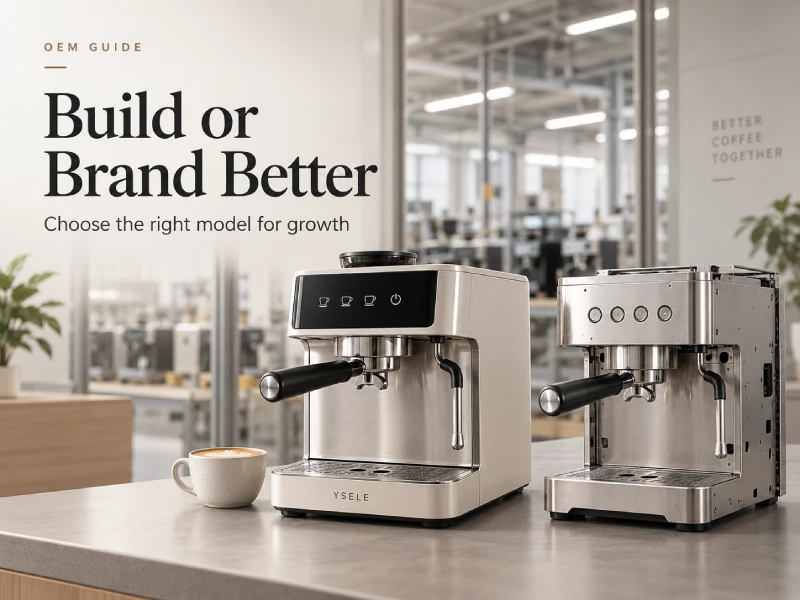
Choosing between an OEM vs ODM coffee machine is not simply a question of which model is better. The right route depends on how much product control you need, how much engineering work your team can manage, how quickly you want to enter the market, and how much development risk you are prepared to take.
For many buyers, starting from a mature platform and adjusting branding, appearance, packaging, or selected configurations can shorten the path to launch. Brands with defined product specifications, differentiated functions, and a long-term plan may benefit more from deeper OEM development.
One important point: OEM, ODM, and private label do not have universally consistent definitions across suppliers. Before starting a project, confirm the exact scope, deliverables, ownership, costs, and responsibilities in writing.
First, Clarify OEM, ODM and Private Label
The terms OEM, ODM, and private label are often used differently by different coffee machine suppliers. For this article, we use the following working definitions.
Private Label
A private label coffee machine normally starts with an existing production-ready model. The buyer mainly changes branding-related elements such as:
- Logo
- Product color
- Nameplate
- Carton artwork
- User manual
- Labels
- Accessories or packaging combinations
The machine structure and major engineering platform usually remain unchanged.
ODM
An ODM coffee machine also starts from a manufacturer-developed platform, but the project may allow a wider range of configuration changes.
Depending on technical feasibility, these can include housing details, control settings, interface elements, accessories, selected components, packaging, and certain functions. The product still relies substantially on an existing manufacturer platform.
OEM
In this article, OEM refers to projects where the buyer provides a more detailed product concept, specification, industrial design, or functional brief and the manufacturer completes the engineering and production work.
OEM may involve new structural parts, electronics, tooling, prototypes, software, testing, and validation.
In real projects, the boundaries can overlap. Always rely on the quotation, technical specification, development agreement, and contract, rather than the label “OEM” or “ODM.”
OEM vs ODM Coffee Machine Comparison Table
The following table provides a practical starting point for comparing coffee machine OEM vs ODM projects.
| Decision Factor | OEM | ODM |
|---|---|---|
| Starting point | Buyer-defined requirement or design | Existing manufacturer platform |
| Product control | Higher buyer involvement | Based on available platform |
| Engineering workload | Usually higher | Usually lower |
| Customization depth | Potentially deeper | Limited by platform feasibility |
| Tooling | May be required | Often less extensive |
| MOQ tendency | Project-dependent — to be confirmed | Project-dependent — to be confirmed |
| Lead-time tendency | More development stages | Fewer development stages |
| Certification | Must be confirmed by model and target market | Existing documents may help, subject to actual configuration |
| IP and tooling | Requires written agreement | Requires clarification of design and usage rights |
| Best fit | Differentiated long-term product programs | Faster market-entry projects |
This table should not be treated as a fixed rule. An ODM project can become technically complicated if the buyer requests substantial functional changes, while an OEM project may still reuse existing modules or components.
MOQ, development cost, tooling, sample charges, and lead time should therefore remain to be confirmed until the manufacturer has reviewed the actual project.
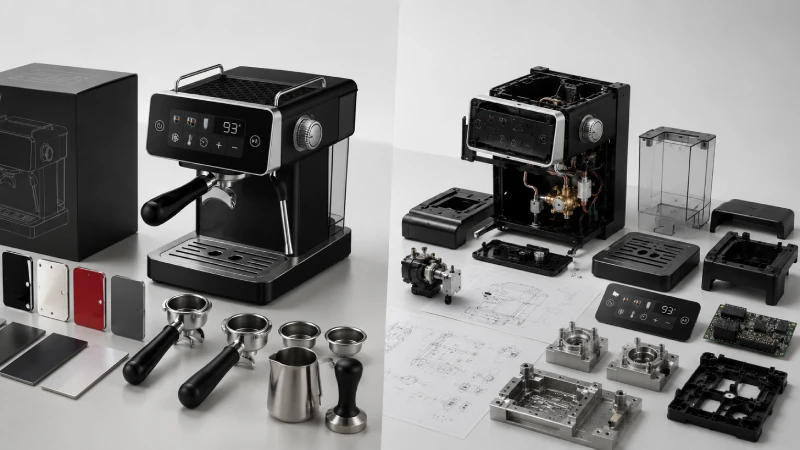
When ODM Is Usually the Better Starting Point
ODM is often a practical starting route when the commercial objective is clearer than the engineering specification.
It may suit buyers who:
- Are entering the coffee equipment category for the first time
- Want to validate demand before investing heavily in development
- Have a clear brand position but no complete engineering design
- Mainly need logo, color, packaging, or selected functional adjustments
- Prefer to begin with a trial order
- Want to choose from an existing product platform
This approach can reduce engineering uncertainty and shorten the route to sampling.
However, ODM does not mean unlimited customization. Structure, heating systems, electronics, dimensions, component layout, or control functions may be constrained by the existing platform. Even a simple request can affect molds, firmware, testing, or sourcing.
Exclusivity should not be assumed. If you require a particular appearance, configuration, territory, or channel to be exclusive, this must be negotiated separately.
When OEM May Be the Better Route
OEM may be more appropriate when product differentiation is an important part of your business strategy.
Typical situations include:
- You already have a detailed product requirement document
- The machine requires a differentiated structure or function
- Your company has an internal project owner
- You have allocated a development budget
- You can accommodate several prototype and validation stages
- You have a long-term product roadmap
- You have specific requirements for tooling, housing, interface, electronics, or key components
For example, an established appliance brand may want its coffee machine to follow an existing design language or use a specific brewing architecture or control interface.
That does not make OEM automatically “higher-end” than ODM. The right choice depends on whether deeper differentiation creates real value for your customers.
Compare the Full Cost Structure, Not Just Unit Price
Comparing only the machine unit price can give a misleading picture. A more useful comparison considers the total project cost, including:
- Product unit cost: production price under the agreed specification and quantity.
- Engineering or NRE cost: mechanical, electrical, firmware, documentation, or development work.
- Tooling: molds or fixtures for customized plastic, metal, or structural parts.
- Prototype and sample cost: samples required during development and approval.
- Custom component MOQ: minimum purchases for custom displays, PCBs, pumps, materials, or printed parts.
- Packaging development: artwork, boxes, inserts, manuals, labels, and packaging tests.
- Testing and certification: requirements based on configuration and target market.
- Pilot production: small runs used to verify assembly and performance.
- Inspection: production or pre-shipment quality checks.
- Spare parts: initial after-sales inventory and service requirements.
- Change-order cost: extra work caused by late design or specification changes.
For these reasons, ODM is not always cheaper and OEM is not always more expensive. Final economics depend on project scope, volume, custom parts, tooling, and compliance requirements.
How the Workflow and Approval Process Differ
One of the clearest differences between OEM and ODM is the number of development decisions required before production.
Typical ODM Workflow
Model Selection → Customization Review → Sample → Packaging & Compliance Confirmation → Golden Sample → Production
The buyer selects a suitable platform, the manufacturer reviews requested changes, and a sample is evaluated. Both parties then finalize specifications, branding, packaging, labels, and compliance requirements. A final approved golden sample should represent the production standard.
Typical OEM Workflow
Product Brief → Feasibility Review → Engineering Design → Prototype → Validation → Tooling or Pilot Run → Golden Sample → Mass Production
OEM usually begins earlier in the development process.
The buyer provides requirements covering functions, dimensions, appearance, performance, target market, and commercial objectives. Engineering teams review feasibility before design and prototyping begin.
Several prototype rounds may be required before tooling or pilot production. OEM therefore normally requires more decisions, more approvals, and stronger change control.
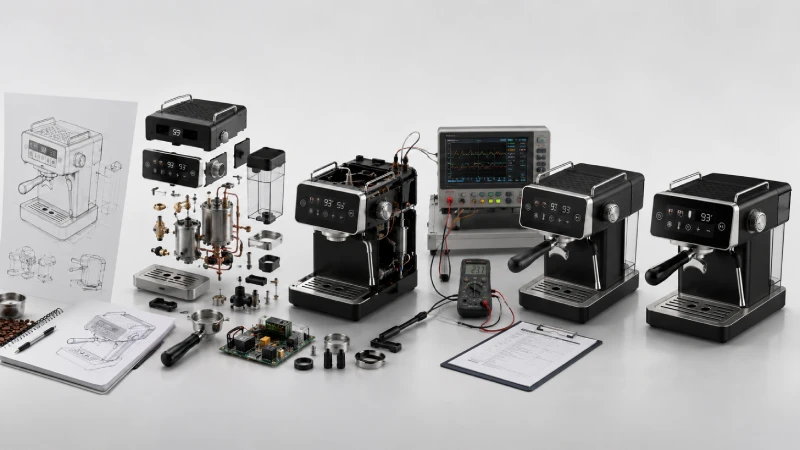
IP, Tooling and Exclusivity Questions Buyers Must Ask
Intellectual property and tooling should be discussed before significant development work begins.
Buyers should clarify:
- Who owns newly developed molds?
- Who pays for mold maintenance and repair?
- Can the tooling be used for other customers?
- Can molds be transferred to another factory?
- Who owns or can use CAD files and mechanical drawings?
- Who controls firmware, interface files, or software created for the project?
- Which pre-existing manufacturer designs remain the supplier’s property?
- Can the final product be offered to another buyer?
- Is territorial, customer, or channel exclusivity available?
- What happens to files and tooling if the project ends?
- Can specified components be replaced without written approval?
Do not assume that paying an engineering or tooling charge automatically gives the buyer ownership of every mold, drawing, software file, or IP right.
Ownership, usage rights, confidentiality, exclusivity, tooling control, and transfer rights should be documented in writing. This framework does not replace legal advice.
Quality, Certification and Change Control
Whether the project is OEM or ODM, production quality depends on controlling the approved specification.
The project file should clearly identify:
- Approved golden sample
- BOM version
- Product specification version
- Critical component requirements
- Packaging specification
- Labels and markings
- Functional test requirements
- Production inspection criteria
The buyer should also establish an engineering change notification process.
Important electrical, mechanical, material, structural, voltage, or safety-related components should not be replaced without approval. Changes can affect previous testing or certification and may require additional evaluation.
Therefore, do not ask only, “Does this coffee machine have certification?”
Ask instead:
Which exact model, configuration, BOM, voltage version, and target market does the available test report or certificate cover?
Decision Matrix by Buyer Type
There is no universal route for every coffee machine buyer. The following matrix is better treated as a starting point for discussion.
| Buyer Type | Main Priority | Likely Starting Route | What to Confirm |
|---|---|---|---|
| New private label brand | Faster market entry | ODM / Private Label | MOQ, branding, packaging |
| Distributor | Product range and repeat supply | ODM | Model availability and support |
| Established appliance brand | Differentiation | OEM or deeper ODM | Engineering, tooling, IP |
| E-commerce seller | Packaging and return risk | Existing platform | Samples and packaging tests |
| Long-term product program | Product ownership and roadmap | OEM | Development resources, tooling and forecast |
A new brand may benefit from launching a proven platform first, while an established appliance brand may prioritize product identity and long-term differentiation. The route should follow the business case, not the terminology used in a supplier’s sales presentation.
Information to Send Before Choosing OEM or ODM
A manufacturer cannot accurately recommend OEM, ODM, or private label based on a message that simply says, “I need a custom coffee machine.”
Prepare a short project brief covering:
- Target country or market
- Coffee machine category
- Reference model, drawing, or concept
- Required functions
- Expected order quantity
- Estimated annual demand
- Target launch schedule
- Required certifications
- Voltage, frequency, and plug
- Branding and packaging requirements
- Sample expectations
- Development budget range
- Exclusivity or IP expectations
The goal is to provide enough information for the manufacturer to determine whether your project should begin with an existing platform or move into deeper development.
For a more detailed RFQ checklist, see What Information Should You Provide for an OEM Coffee Machine Quote?.
FAQ
What is the difference between OEM, ODM and private label coffee machines?
Private label normally involves branding an existing machine with limited changes. ODM starts from an existing manufacturer-developed platform but may allow wider configuration changes. OEM generally involves more detailed buyer-defined specifications or development requirements. Exact definitions vary between suppliers.
Is ODM suitable for a new coffee machine brand?
Often, yes. ODM can allow a new brand to start from an existing product platform instead of funding a complete development program. Buyers should still verify quality, customization limits, certification scope, packaging, MOQ, and supply capability.
Does OEM always require new tooling?
No. OEM projects may reuse standard components, existing modules, or some existing tooling. New tooling depends on the structural and appearance changes required.
Which option normally has a lower MOQ?
There is no universal answer. Existing ODM or private label platforms can sometimes support lower quantities, while custom components may introduce additional MOQs. Actual MOQ is project-dependent.
Can buyers request samples before choosing OEM or ODM?
Yes. A standard or customized sample can help evaluate an existing platform. In OEM projects, prototype samples normally form part of the development and validation process.
Who owns the tooling and product design in an OEM project?
Ownership depends on the agreement. Tooling payment alone should not be treated as proof that the buyer owns all molds, drawings, software, or product IP. Ownership and usage rights should be agreed in writing.