If you want a useful OEM coffee machine quote, your RFQ should include more than a product photo and a request for the “best price.”
At minimum, tell the manufacturer your target market, product category or reference model, estimated quantity, required functions, voltage and plug, certification needs, branding, packaging, sample requirements, target schedule, preferred trade terms, and destination.
These details allow the supplier to quote against a defined project rather than make assumptions. They also make quotations from different manufacturers easier to compare.
A complete RFQ does not necessarily produce the final production price immediately. Samples, engineering review, certification scope, packaging artwork, tooling, or specification changes may still affect the commercial offer.
Why Complete RFQ Information Matters
Coffee machine pricing depends on much more than the visible product design.
Two machines that look similar can have different pumps, heating systems, control boards, accessories, packaging, certification requirements, production quantities, and customization levels. Each can materially change cost.
A structured coffee machine RFQ helps the manufacturer determine:
- Whether the requested product is technically feasible
- Whether an existing model can be used
- Whether the project requires OEM development
- Which customization items affect unit cost
- Whether new components or tooling are required
- What certification or documentation work may be involved
- How packaging affects cost
- What MOQ assumptions should be used
- How the project timeline should be estimated
The quotation should therefore be treated as a project-specific commercial proposal based on the information available at that stage, not simply as a universal price for a coffee machine.
Provide Your Company and Project Context
Start your RFQ with a short explanation of the business behind the project.
Useful information includes:
- Company type
- Your role in the purchasing process
- Target market
- Sales channel
- Brand positioning
- Planned launch date
- Whether this is a first order or an ongoing purchasing program
For example, a distributor supplying appliance retailers may have different packaging, compliance, spare-parts, and repeat-order requirements from a hospitality equipment company purchasing machines for office projects.
You do not need to provide a long company presentation. A few clear sentences are usually enough.
The purpose is to give the OEM coffee machine manufacturer enough context to recommend the right sourcing path rather than evaluate buyers based only on company size.
Identify the Product Category or Reference Model
Next, define what you actually want to buy.
Include the product category, such as:
- Espresso coffee machine
- Capsule coffee machine
- Drip coffee maker
- Coffee grinder
- Commercial coffee equipment
If you have already identified a YSELE model or another reference product, include the model number and reference images.
Also explain:
- Intended use
- Target user
- Required functions
- Preferred functions
- Optional features
- Target product level or market positioning
A useful way to structure the specification is to divide requirements into three groups.
Must-have: Features without which you cannot launch the product.
Preferred: Features you would like to include if technically and commercially practical.
Optional: Features the supplier can evaluate or recommend depending on cost and feasibility.
This distinction is important. If every requested feature is presented as mandatory, the supplier may quote a more complex and expensive configuration than your project actually needs.
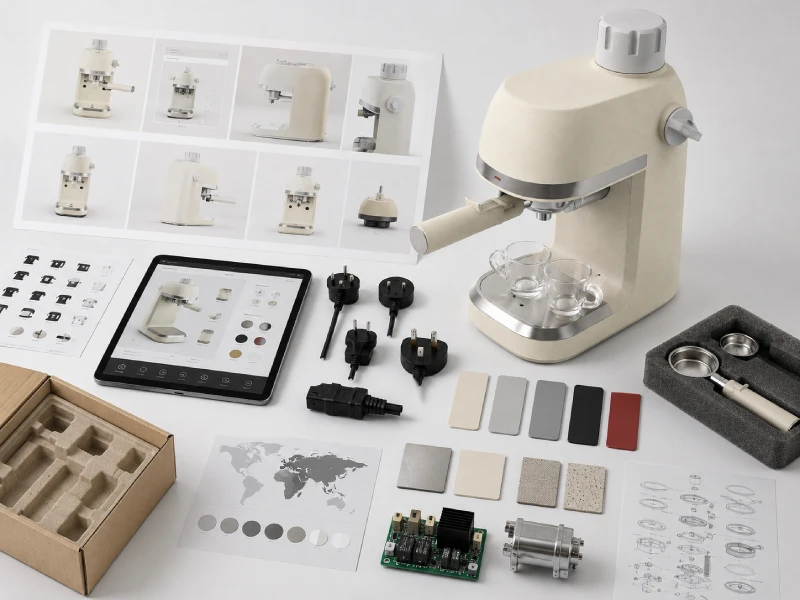
Confirm the Target Market, Voltage, Plug and Compliance
The target country should be provided early in the RFQ.
Coffee machines are electrical appliances, so a specification cannot be evaluated properly without knowing where the product will be sold.
Provide:
- Destination country or countries
- Rated voltage
- Frequency
- Plug type
- Required certification or conformity route
- Rating label requirements
- User manual language
- Packaging language
- Any importer or local compliance requirements already identified
For example, do not simply write “European version.” Specify the countries you intend to enter and any requirements already confirmed by your importer, distributor, laboratory, or certification partner.
When discussing compliance, avoid assuming that an existing certificate automatically covers a new project.
A supplier may be able to provide existing certificates, test reports, component information, or other documents for review. However, their applicability depends on the exact model, configuration, target market, and scope of the certificate.
Final compliance requirements should be verified against applicable local regulations and, where necessary, with the importer and relevant certification or testing organization.
Changes to electrical components, housing, control systems, or other critical parts can also affect the compliance evaluation.
State the Quantity and Order Structure
Quantity is one of the most important inputs in a private label coffee machine quote.
Instead of writing only “please give MOQ,” provide the purchasing structure you currently expect.
For example:
- Sample: 2 units
- First order: approximately 300–500 units
- Repeat order: dependent on sales performance
- Estimated annual demand: 1,000–2,000 units
- Models: 2
- Colors: 2
- Mixed-SKU requirement: yes
- Spare parts: requested with each production order
You do not need to invent an annual forecast if you genuinely do not have one. A reasonable planning range is more useful than an unrealistic number.
The manufacturer can then distinguish sample quantities, initial production volumes, and longer-term purchasing potential.
Define the Required Customization
One of the biggest RFQ mistakes is using “OEM” to describe every type of customization.
Adding a logo to an existing coffee machine is very different from developing a new housing, control system, or internal structure.
Branding
Specify whether you require:
- Printed or applied logo
- Customized nameplate
- Rating label
- Specific logo position
- Other brand identifiers
If artwork is ready, mention the available file format.
Appearance
Describe requirements such as:
- Custom color
- Surface finish
- Housing changes
- Matching accessories
- Decorative parts
Provide a Pantone, RAL, physical sample, or other reference where possible rather than relying only on descriptions such as “dark red” or “premium silver.”
Control and Function
For functional customization, identify changes involving:
- Control panel
- Display
- Button layout
- Interface language
- Brewing settings
- Selected functions
Functional changes may require more engineering evaluation than cosmetic branding.
Structural Development
If the project involves deeper OEM/ODM work, state whether you expect:
- New parts
- New tooling
- Housing development
- Internal structural changes
- Custom electronic or mechanical components
For each requirement, label it as confirmed, preferred, or open to manufacturer recommendation.
This gives the supplier room to propose a practical solution instead of assuming that every initial idea is fixed.
Explain Packaging and Documentation Requirements
Packaging is part of the quotation, not something that should automatically be left until the end of the project.
Your RFQ should explain whether you need:
- Retail color box
- Master carton
- Inner protective packaging
- Customized user manual
- Rating label
- Barcode
- Shipping marks
- Product stickers
- Multiple language versions
- Specific artwork format
- Particular packaging tests
If the machine will be sold through retail or e-commerce channels, mention this because packaging expectations may differ.
When packaging artwork is not yet available, state the required packaging structure and indicate that artwork will follow after product confirmation.
Keeping these requirements visible from the RFQ stage helps prevent unexpected packaging charges or redesign work later.
Define Sample, Testing and Approval Requirements
Explain what the sample is expected to prove.
A sample may be required for:
- Product evaluation
- Function testing
- Appearance approval
- Packaging development
- Certification preparation
- Distributor presentation
- Internal purchasing approval
State the sample quantity and whether you need a standard factory sample or a customized branded sample.
The RFQ should also identify who will approve the sample and which characteristics must be confirmed before mass production.
For OEM projects, it is useful to define when an approved Golden Sample will become the production reference.
Also clarify whether modifications may be requested after sample evaluation. Changes to components, functions, materials, packaging, or structure can require further testing and may affect price, MOQ, tooling, or lead time.
If the approved specification changes materially, the quotation should be reviewed again.
Provide Delivery and Commercial Information
Your RFQ should also establish the commercial assumptions behind the quote.
Provide:
- Expected ex-factory or shipment-ready date
- Destination country or port
- Preferred Incoterm
- Sample delivery preference
- Bulk shipment preference
- Payment expectations
- Pre-shipment inspection requirements
Be precise about dates.
For example, “goods ready by October 15” is different from “arrive at our warehouse by October 15.”
Production lead time and international transport time should normally be discussed separately so there is no confusion about what the supplier’s quoted timeline actually covers.
What the Supplier Should Return in the Quotation
A professional quotation should make its assumptions visible.
When comparing manufacturers, ask them to return as many of the following items as applicable:
- Product model
- Specification or configuration version
- Quoted quantity
- Unit price and Incoterm basis
- MOQ
- Sample cost
- Tooling or engineering charges
- Customized packaging cost
- Certification-related charges
- Estimated timeline by project stage
- Quotation validity
- Payment terms
- Warranty terms
- Spare-parts proposal
- Accessories included
- Items excluded from the price
- Specifications still awaiting confirmation
This is more useful than comparing only the headline unit price.
For example, Supplier A may appear cheaper because packaging, tooling, inspection, spare parts, or certain customization is excluded. Supplier B may have included more of these items.
The goal is therefore not simply to receive several prices. It is to obtain quotations based on sufficiently similar assumptions that they can be compared meaningfully.
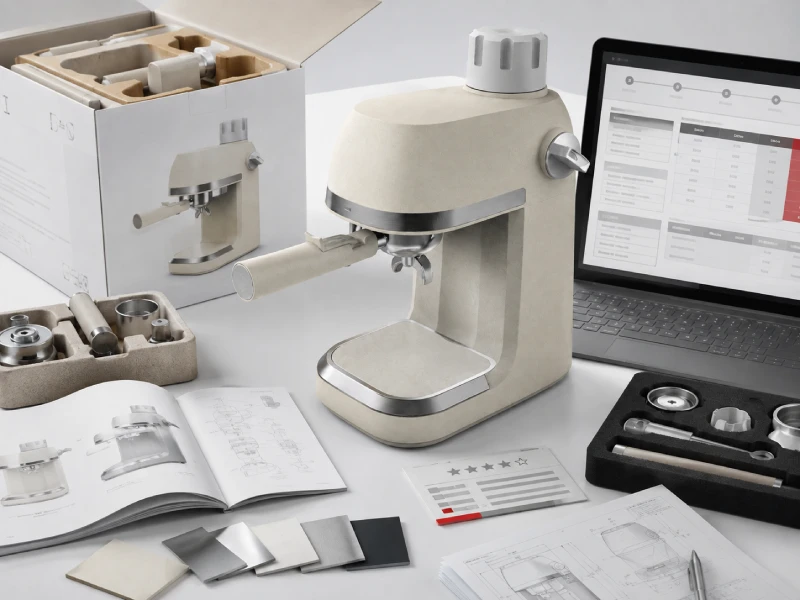
OEM Coffee Machine RFQ Template
You can use the following template when contacting an OEM coffee machine supplier.
| RFQ Section | Information Required | Buyer Input |
|---|---|---|
| Company | Company type and buyer role | |
| Market | Country and sales channel | |
| Product | Product category or reference model | |
| Features | Must-have, preferred and optional functions | |
| Quantity | Sample, first order and forecast | |
| Electrical | Voltage, frequency and plug | |
| Compliance | Certification and label requirements | |
| Branding | Logo, color, control panel and appearance | |
| Packaging | Box, manual, barcode and shipping marks | |
| Sample | Sample type, quantity and testing purpose | |
| Schedule | Target launch or shipment-ready date | |
| Logistics | Destination and preferred Incoterm | |
| Other | Tooling, spare parts or special requirements |
You can also structure your first message like this:
Project: Private label espresso coffee machine
Target market: Germany
Sales channel: Appliance distributors and online retail
Reference model: [Model number / image attached]
Must-have functions: [List]
Preferred functions: [List]
First order: 500 units
Forecast: 1,500–2,000 units annually
Electrical: 220–240V, 50Hz, EU plug
Branding: Logo, custom color, rating label and packaging
Compliance: Please confirm available documents for our review
Sample: 2 customized samples for evaluation
Target: Production ready by [date]
Incoterm: FOB preferred
Destination: [Port / country]
Attachments: Logo, reference images, preliminary artwork and specification sheet
This gives the supplier a workable starting point while clearly showing which details still require confirmation.
Common RFQ Mistakes That Delay Evaluation
Try to avoid these common mistakes:
- Sending only a product photo
- Asking only for the “best price”
- Omitting the target market
- Providing no estimated order quantity
- Forgetting voltage, frequency, or plug type
- Treating logo printing and full product development as the same project
- Failing to separate mandatory and optional functions
- Requesting a final price before the specification is confirmed
- Leaving packaging requirements undefined
- Having no sample approval process
- Setting a target date without considering the complexity of customization
A concise but structured RFQ is usually more useful than a long message containing incomplete or contradictory requirements.
FAQ
Can I request an OEM quote without selecting a final model?
Yes. You can provide the product category, reference images, required functions, target market, quantity, and intended positioning. The manufacturer can then recommend suitable existing models or determine whether development is required.
Does a supplier need the target market before quoting?
It should normally be provided. The market can affect voltage, plug, labeling, manuals, certification scope, packaging, and sometimes product configuration.
Should I provide an annual forecast or only the first order quantity?
Provide both if you have reasonable estimates. The first-order quantity is normally more important for the immediate quotation, while a realistic forecast helps the manufacturer understand the potential order structure. Do not create an artificial forecast simply to obtain a lower price.
What customization information is needed for a private label quote?
At minimum, specify logo requirements, color, label, control panel changes, packaging, manual language, and any required accessories. If functions or structure will change, identify those separately because they may require engineering work.
Can certification costs be included in the quotation?
Where the certification scope can be defined, the supplier may be able to identify relevant charges. However, requirements must first be confirmed for the exact product configuration and target market. Additional testing or changes may affect the eventual cost.
When should the Golden Sample be approved?
The Golden Sample should normally be established after the agreed product specification and required modifications have been validated and before mass production starts. It should clearly represent the approved configuration used as the production reference.
Can the quotation change after sample evaluation?
Yes. If sample evaluation results in changes to components, functions, materials, tooling, packaging, testing, or other specifications, the commercial assumptions may change. The revised configuration should be reviewed and, where necessary, re-quoted.